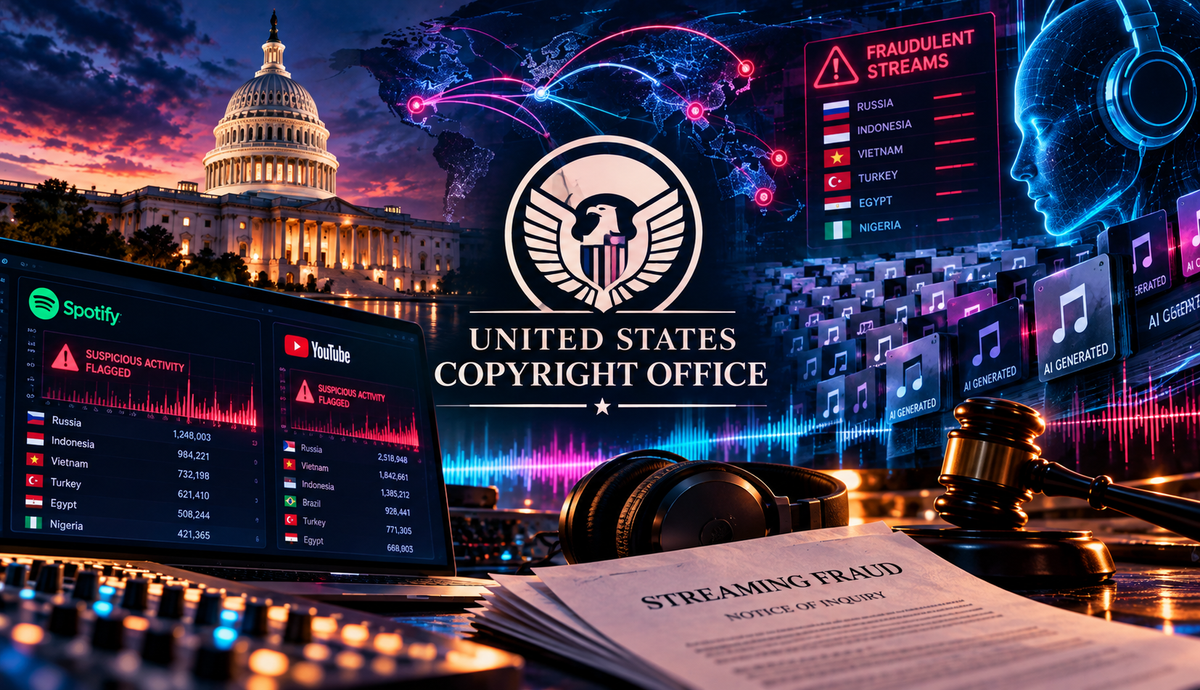
The U.S. Copyright Office issued a formal Notice of Inquiry on October 7, 2026, examining how fraudulent streaming activity affects the music industry, copyright owners and royalty distributions. The inquiry follows a request from U.S. Representative Scott Fitzgerald and seeks input from record labels, publishers, songwriters, distributors, streaming platforms and other stakeholders. Its purpose is to help Congress understand the prevalence of streaming fraud, evaluate existing safeguards and consider potential responses.
How Streaming Fraud Works and How Platforms Respond
Streaming fraud occurs when listening activity is artificially generated or manipulated to inflate play counts and collect royalties without genuine consumer engagement. Common methods include automated bots, click farms, manipulated playlists and networks of fraudulent listener accounts.
Streaming platforms such as Spotify monitor suspicious listening patterns, including sudden unexplained increases in plays, repetitive activity and streams originating from countries where an artist has little established audience. Geographic anomalies can be warning signs, but listening from an unexpected country is not, by itself, evidence of fraud. Platforms evaluate patterns of activity to distinguish legitimate audience growth from manipulation.
When Spotify identifies artificial streams, those plays are excluded from eligible royalty calculations and public streaming metrics. Associated royalties may be withheld rather than paid to the recording rightsholder through its label or distributor.
The Michael Smith Case: AI Music and Billions of Artificial Streams
The urgency of the issue was reinforced by the recent sentencing of Michael Smith, a North Carolina musician who operated a large-scale streaming fraud scheme involving AI-generated recordings and automated listener accounts.
AmbI previously wrote about this case here.
AI Creates a Second Challenge for an Existing Fraud Problem
Streaming fraud is already a significant problem before generative AI became widely accessible. The industry has spent years developing systems to identify artificial streams, investigate suspicious accounts and prevent royalty payments from being diverted away from legitimate music.
Generative AI introduces an additional challenge by dramatically reducing the time and cost required to create large volumes of new recordings. Although AI-generated music is not inherently fraudulent, the ability to produce and distribute recordings at enormous scale creates additional opportunities for bad actors to disguise manipulation across thousands of tracks.
What Happens Next? Public Comments Are Open
The Copyright Office is inviting public comments about how streaming fraud operates, the financial harm it causes, the effectiveness of current detection systems and possible voluntary, regulatory or legislative responses.
Public comment deadlines:
- November 23, 2026, at 11:59 p.m. Eastern: Initial written comments.
- December 21, 2026, at 11:59 p.m. Eastern: Reply comments.
Submit a Public Comment — U.S. Copyright Office
The official page provides instructions and links to the federal Regulations.gov submission form. Individuals and organizations can participate. Short comments may be entered directly into the online form, while longer submissions can be uploaded as documents. Submitted comments and accompanying files become publicly available. Comments can be submitted through the federal Regulations.gov website here.
Join the discussion